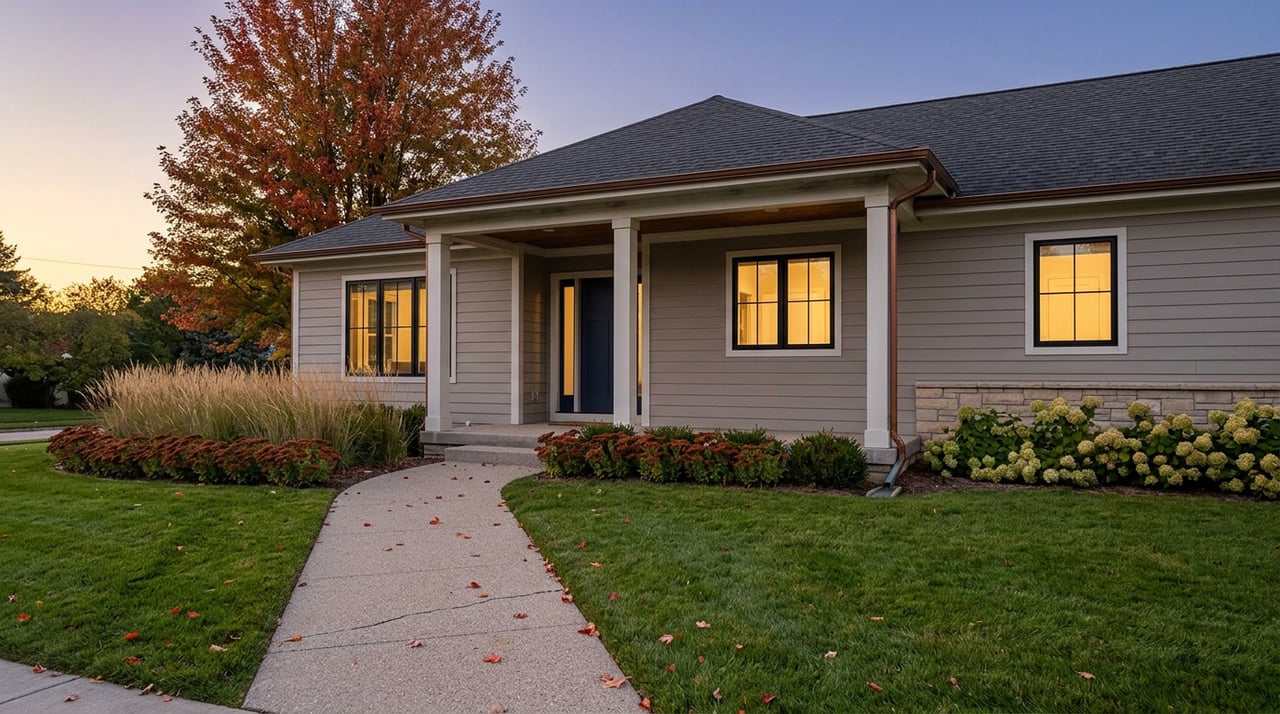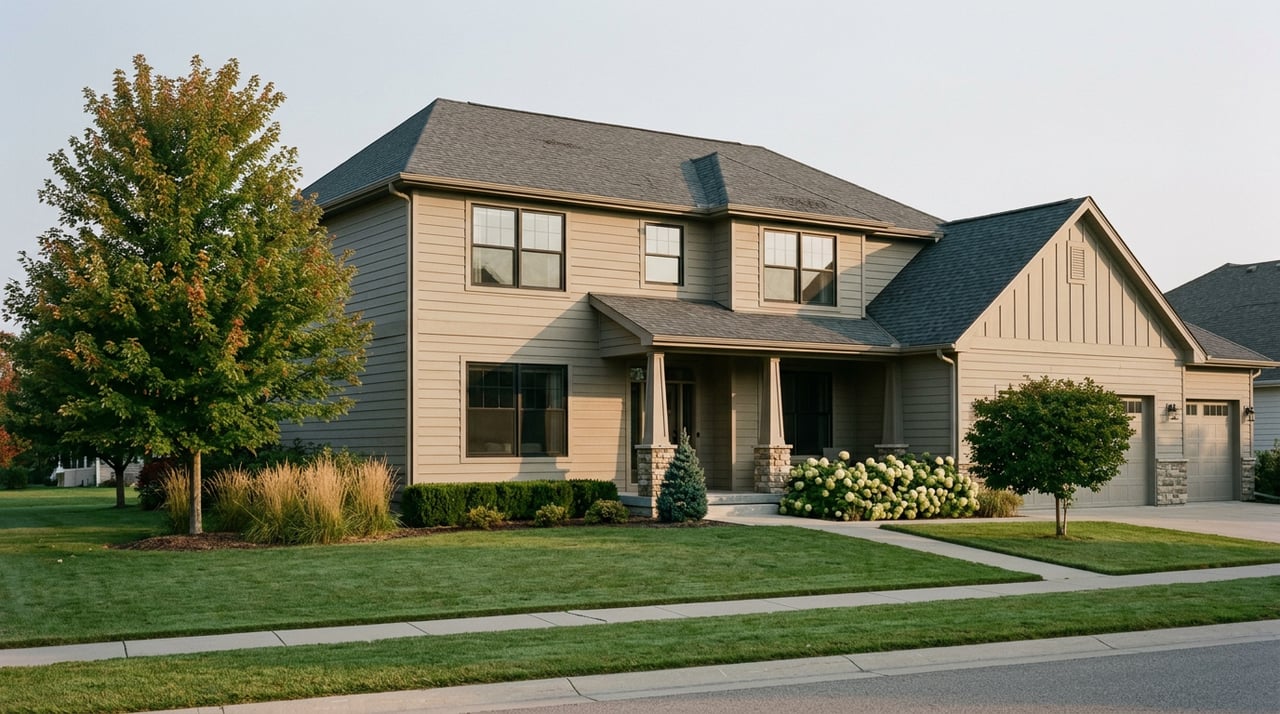
Why does a home in New Richmond cost roughly $100,000 less than one in Hudson, fifteen minutes down Highway 64, in the same county, feeding the same commuter corridor into the Twin Cities? The easy answer is distance. The real answer starts at the utility pole.
Both cities sit in St. Croix County, Wisconsin. Both draw workers into Hudson's retail base and across the river into Minnesota. Both show up on the same relocation shortlists for buyers comparing western Wisconsin to the metro. And yet the price gap between them is wide enough that it deserves more explanation than "New Richmond is a little farther out."
The Numbers Side by Side
As of June 2026, Zillow put Hudson's typical home value at $454,490, up 2.9% over the prior year. New Richmond's typical home value sat at $346,691 over the same window, down 1.1% year over year. That's a gap of more than $107,000 between two cities that share a county line.
Redfin's data adds texture on the Hudson side specifically: over the three months ending June 2026, Hudson's median sale price was $420,000, up 3.0% compared to the same period the year before, with homes selling in an average of 29 days.
| Hudson, WI | New Richmond, WI | |
|---|---|---|
| Typical home value (Zillow, June 2026) | $454,490 | $346,691 |
| Year-over-year change | +2.9% | -1.1% |
| Median sale price, 3 mo. ending June 2026 | $420,000 (Redfin) | — |
| Average commute time | — | 25.1 minutes (Data USA) |
| Primary electric provider | Xcel Energy | New Richmond Utilities |
New Richmond's own commute data tells you the towns aren't functioning as separate labor markets. The average one-way commute for New Richmond residents is 25.1 minutes, and most of that traffic runs toward Hudson and the Twin Cities along Highway 64 and Highway 65. If the two cities were meaningfully far apart in daily life, you'd expect that number to be much longer. It isn't. So distance alone is a thin explanation for a six-figure price gap.
Who Owns the Poles
Here's the piece of the puzzle that doesn't show up on a listing sheet. Hudson's electric and natural gas service comes from Xcel Energy, an investor-owned utility that operates across eight states and answers to shareholders. New Richmond runs its own show. New Richmond Utilities has been a municipally owned electric and water utility since 1890, serving more than 4,850 customers directly, with rates set to cover the cost of service rather than to generate a return for outside investors.
That structural difference shows up in the bill. New Richmond Utilities' own published rate comparison puts its average monthly residential electric bill at $83.13, against $87.91 for Xcel customers in the same comparison. It's not a dramatic gap on any single month's bill, but it's a real, recurring, structural one, and it compounds over years of ownership in a way a single closing statement never captures.
This is the kind of detail that gets lost when a buyer is only comparing list prices across a county line. A lower purchase price in New Richmond isn't just about square footage or lot size. Part of it reflects a genuinely different ownership model for the utility running through the walls.
A Decade of Wires Headed for Hudson
There's a second layer to this, and it's more recent. According to a notice posted by the Town of Hudson in October 2025, Xcel Energy is proposing a new transmission line connecting the 115kV line north of River Falls to the 115kV line north of Hudson, framed explicitly around the growth pressure both cities are putting on the existing grid. Per that notice, Xcel intended to file a Certificate of Public Convenience and Necessity with the Public Service Commission of Wisconsin in early 2026, with construction anticipated to begin in 2028 and run through 2031.
That's a multi-year capital project on Hudson's side of the grid, and it's worth understanding what that means and doesn't mean. It doesn't mean your electric bill jumps next year if you buy in Hudson. It does mean that Hudson's utility infrastructure is entering a build cycle tied directly to how fast the area is growing, and regulated utilities like Xcel typically recover major capital investments through customer rate cases over time. New Richmond, meanwhile, is not part of that specific project. Its grid is smaller, locally governed, and has operated on a different cost structure for over a century.
Municipal Doesn't Mean Frozen
None of this means New Richmond's utility costs are locked in place forever, and it wouldn't be honest to suggest that. New Richmond Utilities has also filed an application with the Public Service Commission of Wisconsin to raise water rates. Municipal ownership doesn't freeze prices. It changes who sets them, who benefits from the cost of service, and how directly the decision connects back to the community actually using it.
For a buyer weighing the two cities, that's a more useful frame than "cheaper" versus "more expensive." One city buys into a large, investor-owned utility mid-build on a decade-long transmission project. The other buys into a small, locally governed utility with a different rate philosophy and its own pending adjustments. Both are legitimate. They're just not the same thing, and the difference doesn't show up anywhere on a comparative market analysis.
What This Actually Means If You're Comparing the Two
If you're cross-shopping Hudson and New Richmond, the honest way to use this information isn't to declare a winner. It's to add a line item to your comparison that most buyers skip entirely.
- Ask who the electric and water provider is for any specific address, since utility territory doesn't always follow city boundaries exactly.
- Pull a recent utility bill from the seller if you can, rather than relying on averages. A single home's usage pattern will tell you more than a citywide comparison.
- Understand that a lower purchase price in New Richmond reflects several layers, not one. Distance from downtown Minneapolis and St. Paul is part of it. Utility ownership structure is another part that rarely gets named out loud.
- Don't treat Hudson's higher price as a penalty. Its proximity, established commercial base, and larger inventory come with real trade-offs of their own that this utility comparison doesn't capture.
The point isn't that one city is the better financial decision. It's that the price gap between two neighboring St. Croix County communities is more structural, and more explainable, than most portals let on.
FAQ
Does New Richmond's lower electric rate mean it's cheaper to live there overall? It's one factor among several, not a full cost-of-living verdict. Property taxes, insurance, commute costs, and the home itself all matter more in most household budgets than a few dollars a month on an electric bill. Use it as one data point, not the whole picture.
Will Hudson's transmission project raise electric rates for current homeowners? The Town of Hudson's notice describes the project's scope and timeline, not its eventual cost to ratepayers. Major utility infrastructure projects typically get addressed in separate rate cases before the Public Service Commission of Wisconsin, and that process hadn't been finalized as of the most recent notice on file.
Is New Richmond within reasonable commuting distance of the Twin Cities? New Richmond's average one-way commute runs about 25 minutes, with most of that traffic moving toward Hudson and across into Minnesota via Highway 64 and Highway 65, according to Data USA's most recent commuting data for the city.
If you're weighing Hudson against New Richmond, or trying to figure out what a specific address's utility provider and true carrying costs look like, that's exactly the kind of ground-level comparison Farida Karundeng works through with buyers on both sides of the St. Croix every week. Let's Connect and look at the numbers for your specific situation, not just the citywide averages.